Home
About Us
Services
Industries
Our Difference - WiSNET
Blog Contact Us
Book a 20 minute uplink review 646-647-3160

Managed satellite & Starlink internet.

High speed satellite internet, professionally managed. SLICE Wireless installs, integrates, and monitors Starlink uplinks as primary or automatic fallback connectivity. You get the capacity. We carry the complexity.

A second Starlink hardware option, an upright satellite dish on a free standing base Starlink Standard satellite dish, the hardware SLICE Wireless installs and manages Residential Enterprise
11,143Satellites overhead now
25–45 msTypical latency
24/7Network monitoring
A Starlink satellite dish on the rooftop terrace of a modern building at dusk, overlooking a mountain lake, with a line of satellites arcing across the sky above

What is Managed Satellite Internet?

It means somebody else takes responsibility for the hard part. We choose the gear, put it on the roof, wire it into your network, and keep an eye on it from then on. You are buying a connection that works, not a dish in a box.

The cost of one bad hour

Don’t let your whole building lean on one cable.

$300K+

What one hour offline costs more than 9 in 10 mid size and large companies.

Source: ITIC Hourly Cost of Downtime Survey, 2024
41%

Of companies put a single hour offline at $1 million to $5 million, or worse.

Source: ITIC, 2024
97%

Companies over 1,000 staff lose more than $100,000 an hour offline.

Source: ITIC Downtime Survey Part 2, 2024

How a SLICE uplink goes live.

Phase 1

We map the sky before we touch the roof.

A low earth orbit terminal tracks satellites as they cross overhead, so a parapet wall or a single mature tree does not cause one clean outage. It causes dozens of short ones. We survey the field of view from every candidate mount point and choose the position that clears it.

Phase 2

Mounted for a Northeast winter, not a fair weather afternoon.

Non penetrating ballast frames, pole and parapet mounts, custom steel where the building demands it. Cable pathways sealed, grounded, and routed properly, because the fastest way to lose an uplink is a connector nobody weatherproofed.

Phase 3

Bridged into the network you already run.

We put the terminal in bypass mode and terminate on your firewall, clearing the double NAT that breaks inbound services and site to site tunnels. Then we write the failover policy, the health probes, and the traffic rules so the link behaves like a circuit, not a consumer gadget.

Phase 4

Watched continuously. Fixed before you notice.

Latency, jitter, packet loss, and obstruction events stream back to our engineers around the clock. Thresholds trigger alerts, alerts trigger people, and hardware faults trigger a replacement we coordinate on your behalf.

The easy way

We take the messy part.

Done badly, satellite internet is a long list of things that go wrong. Blocked sky, tangled routing, a backup that never kicks in. Done properly, it is a connection you stop thinking about. Everything in between is our job.

Service offerings

3 Things we take off your desk!

Installation and set up

We handle the physical and digital deployment from start to finish to guarantee maximum uptime and peak performance.

  • Obstruction mappingPrecision alignment that eliminates dropped signals from trees, parapets, and neighbouring buildings.
  • Custom mountingSecure, ruggedized installation on roofs, poles, or purpose built infrastructure.
  • Hardware integrationProfessional cabling and bridging directly into your existing routers, switches, firewalls, and WiFi access points.
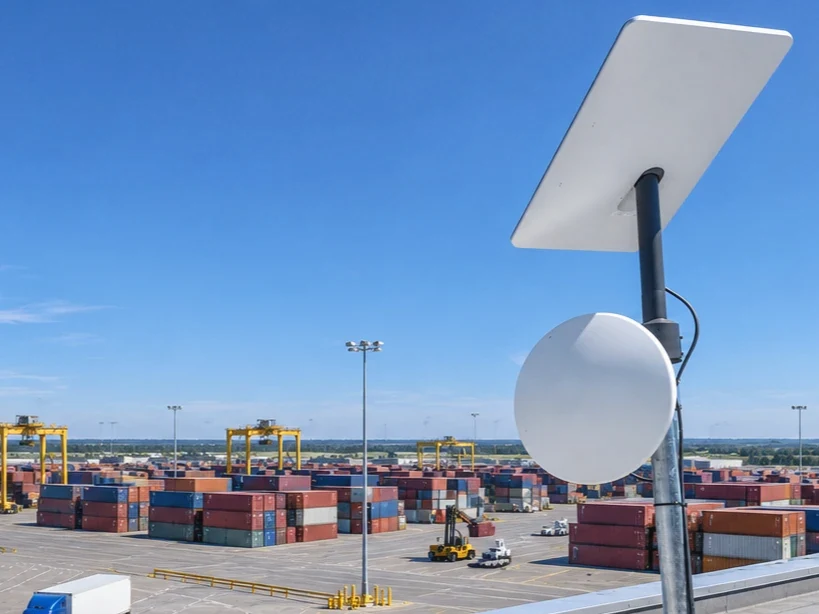
A Starlink flat panel and a parabolic antenna mounted together on a galvanized mast above an intermodal container yard, with stacked shipping containers and gantry cranes behind

Cost effective configuration

Avoid over purchasing hardware or subscribing to the wrong service tier. We match your measured demand to the most economical plan that still meets it.

  • Plan selectionExpert guidance across Residential, Business, Priority, and Mobile or Roam tiers.
  • Hardware right sizingThe exact gear you need, with no spend on adapters and high performance dishes you will never use.
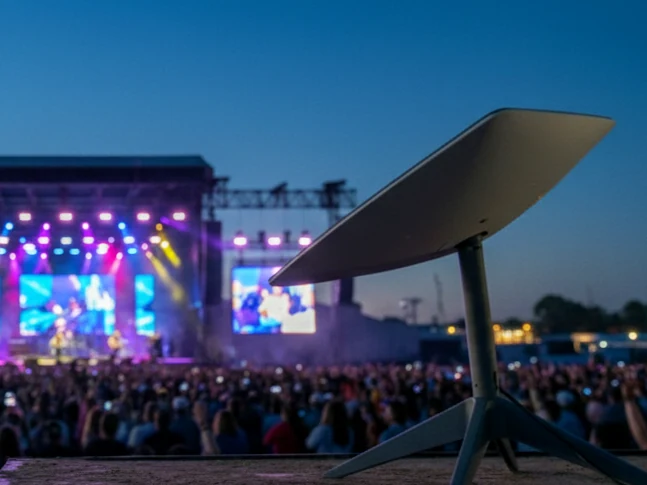
  • Temporary and event WiFiShort run uplinks and the WiFi network behind them for festivals, venues, and pop ups, on Mobile or Roam tiers, sized for the crowd and removed when the dates end.
A Starlink dish on its tripod supplying temporary event WiFi at an outdoor concert at dusk, the stage lit in purple and blue beyond a dense crowd

Managed service and fault resolution, 24/7

Proactive oversight that catches degradation before it reaches your staff, your tills, or your guests.

  • Proactive monitoringContinuous remote tracking of latency, packet loss, obstruction events, and connection health.
  • Immediate fault resolutionAutomated alerts put our engineering team on the problem the moment thresholds break.
  • Hardware safeguardsRapid diagnostics and coordinated equipment replacement if a unit fails.
A bright network operations floor with daylight windows and wall monitors showing red and white telemetry from monitored satellite and WiFi networks
Service area

Four states.
One engineering team.

New YorkNYC metro · Hudson Valley · Long Island
New JerseyNorth Jersey · Shore · Delaware Valley
PennsylvaniaPhiladelphia · Lehigh Valley · Poconos
ConnecticutFairfield · New Haven · Hartford
Check your address
Ready when you are

Let us get your site set up.

Survey, mounting, integration, and network monitoring for offices, venues, and events, handled end to end across New York, New Jersey, Pennsylvania, and Connecticut.

Questions

Straight answers.

More in the SLICE knowledge base

Yes, for many sites. Ookla put the United States median Starlink download speed at 117.74 Mbps, which comfortably supports voice, video conferencing, cloud applications, and point of sale for a typical small or mid sized location. SLICE sizes the link against your concurrent user count and application mix rather than a headline number. Where a site genuinely cannot tolerate a single point of failure, we pair the satellite uplink with a terrestrial circuit under automatic failover instead of choosing between them.

Reference: Ookla 2025 Global Satellite Broadband Performance Report

Yes. Temporary and event WiFi is a core SLICE service, and a satellite uplink is often what makes it possible, because festivals, construction sites, pop ups, and disaster response sites rarely have a circuit waiting. We size the uplink to the expected crowd, build the WiFi network behind it, run it for the dates you need, and take it down afterwards.

Where a venue already has fiber, the satellite link sits behind it as automatic failover, so a cut cable does not stop ticketing or payments. The full event side lives on the SLICE temporary WiFi for events page.

SLICE configures dual WAN or SD-WAN policy with active health probes, so the edge device detects loss or latency breach on the primary path and shifts traffic without waiting for a human. With session persistence configured correctly, most users experience a brief pause rather than a dropped call. We prove it during commissioning by pulling the primary circuit while somebody is mid meeting.

Obstruction mapping surveys the sky from each candidate mount point before anything is bolted down, so the position is chosen on evidence rather than convenience.

A low earth orbit terminal does not lock onto one fixed point in the sky. It tracks satellites crossing overhead and hands off between them continuously. That means a tree limb, a wall, or a neighbouring rooftop plant room blocking part of the field of view does not produce one obvious outage. It produces dozens of brief interruptions that look like a flaky network and are miserable to diagnose after the fact.

It depends on how much the site leans on the link. Residential and Residential Lite tiers are reasonable where satellite is pure insurance. Business and Priority tiers add prioritized network access and higher thresholds before deprioritization, which matters for sites running revenue systems through the connection. Mobile and Roam tiers cover vehicles, vessels, and locations that move.

Tier structures and prices are set by the operator and change periodically, so SLICE validates the current line up at the point of order and matches it to measured demand rather than guesswork.

Satellite terminals typically issue a carrier grade NAT address and run their own router with its own DHCP scope. Put that in front of an existing firewall and you now have two layers of address translation, which breaks inbound services, site to site VPN tunnels, some SIP traffic, and anything that depends on a stable public address.

SLICE resolves it by placing the terminal into bypass or bridge mode and terminating the connection on your firewall, so routing, VPN, and quality of service policy remain in one place and under your control.

Heavy precipitation can attenuate the signal briefly, and the effect is far smaller than it was on older geostationary services operating at higher frequencies over much longer paths. Properly mounted terminals with a clear field of view ride out ordinary Northeast weather. The failures we are called to fix are overwhelmingly obstruction and configuration problems, not rain.

Terminals include a heating element for snow and ice, which is one of several reasons power design at the mount point is part of our survey rather than an afterthought.

Yes. SLICE can procure the dish, mounts, cabling, and routing hardware and manage the satellite service agreement on your behalf. You receive one invoice and one accountable party rather than coordinating a hardware vendor, a service provider, and an installer who each point at the other when something stops working.

Most single site deployments run from survey to live traffic within one to two weeks, and the on site work itself is usually a single day. The variables that move that timeline are roof access and building management approval, the cable pathway, and whether the structure requires an engineering review of the mount before installation.

Next step

Twenty minutes.
A real engineer.
No deck.

Already have Starlink and it is misbehaving?

Dropped sessions, high latency spikes, VPN tunnels that will not hold, double NAT conflicts. Send us the symptoms and we will tell you what we think is wrong before you spend anything.

We reply within one business day. Your details are used to respond to this enquiry and nothing else. Prefer email? Write to sales@slicewifi.com.